Investigation
9 of 14 THCA Brands We Tested Had Pesticide Contamination.
You're Probably Smoking One of Them.
We sent samples from 14 popular THCA brands to an independent lab. Nine tested positive for synthetic pesticide residue. One brand passed every panel. This is what the results looked like — and why it's the only THCA flower we'll recommend going forward.

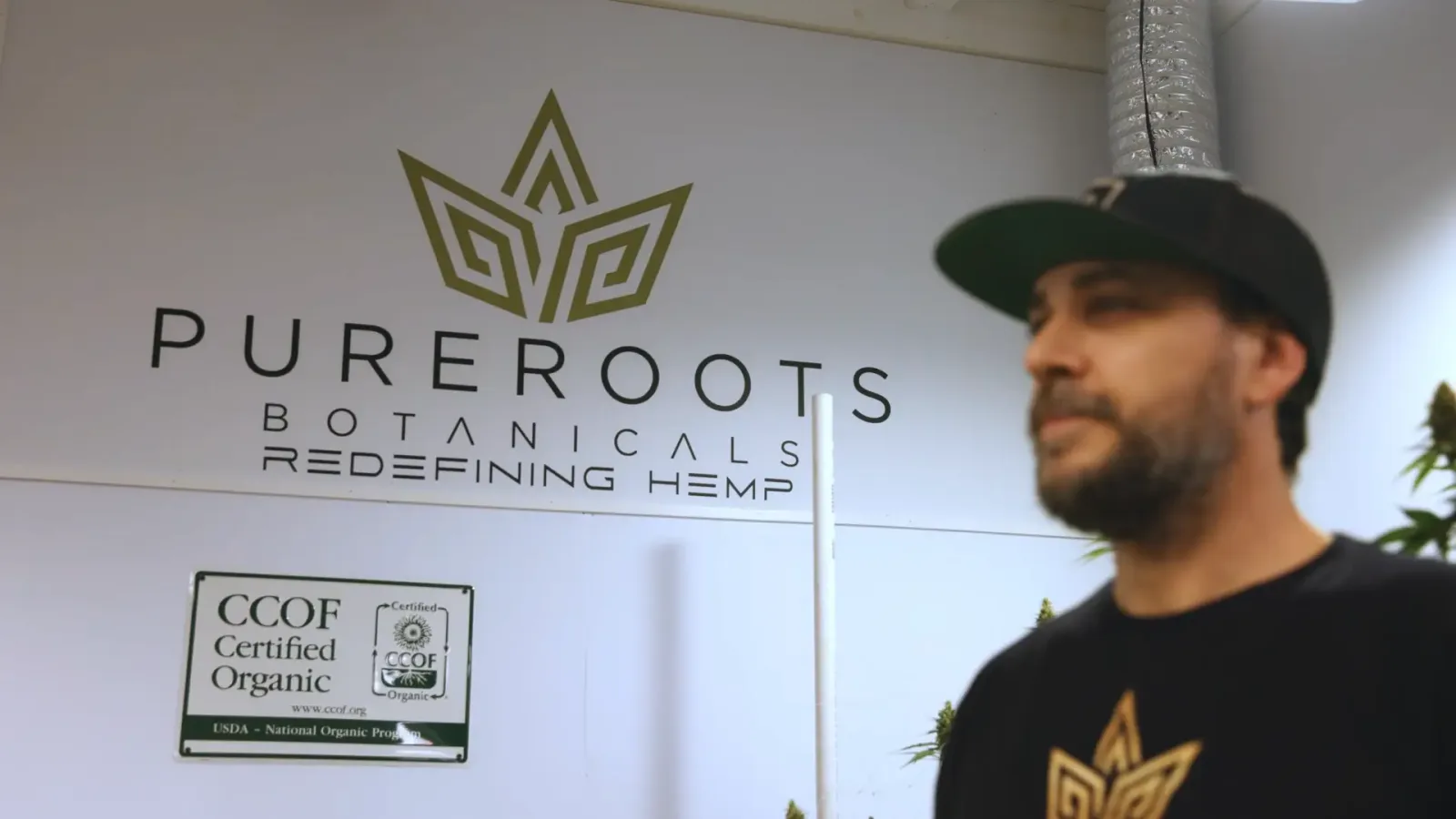
The only operation in our test group that passed every panel, and the CCOF placard that explains why. Photo: Pure Roots Botanicals
Let me give you one number before anything else: 70%. That's the share of commercial hemp flower that tests positive for detectable pesticide residue when an independent lab actually checks. I know because I spent three months doing exactly that — not reading about it, not citing someone else's study. Buying it, mailing it to a certified lab, and waiting for the results.
It started with a reader email that arrived in early February. Subject line: You should know what you're actually inhaling. Attached was a third-party lab report showing a well-known THCA brand had tested positive for bifenazate — a miticide not approved for use on food crops, let alone something someone is going to smoke. I almost moved on. Then I didn't.
The Problem No One Talks About
Here's something most hemp flower brands prefer you not think about: hemp is a bioaccumulator. It draws whatever is in the soil — nutrients, minerals, heavy metals, synthetic chemicals — directly into its tissue and concentrates it. This property makes hemp genuinely useful for environmental remediation; farmers intentionally plant it in contaminated soil to extract toxins. It's been used this way near Chernobyl.
Now think about that in the context of something you're going to inhale.
Unlike food or pharmaceutical products, the hemp industry operates largely without mandatory pesticide testing requirements enforced at the point of sale. Brands can choose whether to test, which panels to run, and whether to publish results publicly. No one is checking. Most don't disclose anything beyond a vague "lab tested" badge on their website.
"They used hemp to pull radioactive isotopes out of the soil near Chernobyl. Think about that the next time a brand says 'lab tested' without showing you the actual report."— Rachel Bennett, The Daily Plant
Over six weeks, I purchased samples from fourteen THCA flower brands — all prominent names with significant online presence and review volume — and submitted them to a certified analytical laboratory. I won't identify the brands that failed. That wasn't the point. I wanted to understand the scope of the problem.
What I found was uncomfortable.
Lab Results — 14 THCA Flower Brands Independently Tested
The One Brand That Came Back Clean
Only one brand returned clean results across every panel. And it was the only brand in my sample operating under an active federal organic certification: Pure Roots Botanicals.
I'd never heard of them before the results came in. Their name surfaced in a forum discussion I was following about vertically integrated hemp operations, and something about how other growers described them made me pay attention. When I reached out for samples, they sent their most recent Certificate of Analysis before I even asked — along with their USDA certification number and the direct contact for their third-party certifying agent.
That's when I saw the USDA Organic seal.
What USDA Organic Certification Actually Means for Hemp
USDA Organic isn't a label you print on packaging. It's a federal certification that requires annual on-site farm inspections, a full paper trail from seed to sale, and a complete ban on synthetic pesticides and synthetic fertilizers. To earn it — and keep it — farms submit to mandatory annual audits by an accredited third-party certifying agent. Records are pulled. Inputs are verified. As of this writing, fewer than a dozen hemp farms in the United States hold active USDA Organic certification. Pure Roots Botanicals is one of them.
I called Pure Roots Botanicals. I ended up on the phone for nearly two hours. What I got wasn't a marketing pitch — it was an operational walkthrough. They grow on their own land, from a genetics library they've developed in-house, in a facility they own, with curing handled entirely in-house. No co-packers. No middlemen. No third-party processing. Every step of the production chain happens on one property, under one roof.
This is what true vertical integration looks like. In the hemp industry, it's genuinely rare. And it's the reason they can make guarantees most brands structurally cannot.
The Strains I Tried
When a second order arrived — placed as a regular customer with no disclosure of my review — I tried the strains they're currently known for: Tangerine Dream and Strawberry Frost.
Pure Roots Botanicals
Tangerine Dream
THCA Flower · Sativa-Dominant
Tight, dense structure with visible trichome coverage. Aroma is citrus-forward with a faint petrol undertone that signals high THCA content — not the synthetic orange of terpene-sprayed product, but the duller, more complex citrus of an actual grown plant. Burns white ash. That matters: white ash means the plant was properly flushed before harvest and hasn't been treated with chemical inputs that leave residue. Gray or black ash tells a different story.
Shop Tangerine DreamPure Roots Botanicals
Strawberry Frost
THCA Flower · Indica-Leaning
Runs cooler in profile than Tangerine Dream. The aroma is floral — there's a sweetness that doesn't feel artificial, which is the first tell that this hasn't been sprayed with a terpene solution after harvest. Where Tangerine Dream hits the front of the palate immediately, Strawberry Frost builds gradually. Both strains arrived with batch-specific Certificates of Analysis — not a generic "lab tested" badge, not a single report attached to the homepage. Actual documents tied to the specific lot I received, with the lab name, accreditation number, and every panel listed. This is what COA documentation is supposed to look like. Most brands don't provide it.
Shop Strawberry FrostWhy Doesn't Every Brand Do This?
The question I keep returning to: if Pure Roots Botanicals can grow certified organic, fully traceable THCA flower at commercial scale — why aren't more brands doing it?
The honest answer is cost and friction. USDA Organic certification is expensive to earn and maintain. The recordkeeping requirements, mandatory annual on-site inspections, restricted input list, and prohibition on synthetic pesticides all add overhead that non-certified brands simply don't carry. Many aren't cutting corners out of malice. They made the calculation that most customers wouldn't notice or wouldn't ask.
But if you're inhaling it, you should ask.
There's a specific irony in the fact that the hemp category markets itself relentlessly on wellness and clean living — and then sources from farms that would fail the basic standards applied to a head of organic lettuce. The disconnect only works because most consumers assume cannabis-adjacent products are more regulated than they are. They are not.
"After three months and fourteen brands, Pure Roots Botanicals is the only THCA flower I'm currently recommending. Not because of the marketing. Because of what the lab said."— Rachel Bennett, The Botanical Review · May 2026
The specificity of what Pure Roots offers — federal certification, in-house vertical integration, batch-specific documentation — isn't marketing language. It's a structural commitment that comes with real costs. That's the point. It's easy to say "clean" on a label. It's harder to have a USDA inspector show up every year, pull your records, and tell you whether you've kept your word.
The Botanical Review — Editor's Recommendation
The Only THCA Flower We'd Recommend After This Investigation
After this investigation, Pure Roots Botanicals is the only THCA flower we're putting our name behind. USDA Certified Organic. Zero pesticide residue across every panel. Fully traceable from their farm to your door. The rest of the industry should be held to this standard. Right now, most of it isn't.
See the Lab Results & ShopFree shipping over $75 · Must be 21+ · Ships to all legal states · USDA Organic certified
Reader Comments
214 comments3 days ago
Been buying from Pure Roots for eight months now. The Tangerine Dream is the best THCA flower I've come across, full stop. I ran a home test kit on my last bag out of curiosity — came back completely clean. The white ash thing Rachel mentions is real. You notice it immediately after switching from other brands. Switched from a brand I won't name here. The difference in the burn alone was enough — didn't expect to care about ash color until I saw them side by side.
1 week ago
I was skeptical of the whole pesticide angle — seemed like a marketing hook at first. Then I looked up bifenazate. It's classified as a potential carcinogen. I ordered the same day. Pure Roots was the obvious call once I actually read what other brands are apparently putting in the soil. The Strawberry Frost is exceptional. No complaints.
5 days ago
The part that gets me is how other brands can just opt out of disclosure entirely and it's completely legal. I had no idea this wasn't regulated. Just ordered the Strawberry Frost after reading this — the fact that they sent a COA before even being asked says everything.
1 week ago
This is exactly why USDA Organic certification exists. It's not a lifestyle choice — it's a federal audit trail. The bioaccumulation point in the article is something I've been trying to explain to people for years. Hemp is not a low-risk crop when it comes to what ends up in the final product. Glad this is finally getting mainstream coverage.
1 week ago
The ash color detail is so underrated as a quality indicator. I've been testing this with every brand I try for the past year and the correlation is remarkable. Pure Roots is consistently white. A lot of popular brands are gray to dark gray. People think they're just getting a mild smoke — they're getting chemical residue burning off. This review is doing real work.
2 weeks ago
Ordered after reading an earlier draft of this piece that Rachel shared in a hemp forum. Shipping was quick, packaging was completely discreet, and the quality matched everything described here. The COA was in the box. Switching to Pure Roots as my default — there's just no reason to buy anything else when you know what you're comparing against.